Smart Hotel Cardless Power Control
Traditional hotel card-slot systems only know whether a card is inserted. They do not know whether the guest is actually in the room. When a spare card is left in the slot after the guest leaves, air conditioning, lighting, and other room devices may continue running in an empty room.
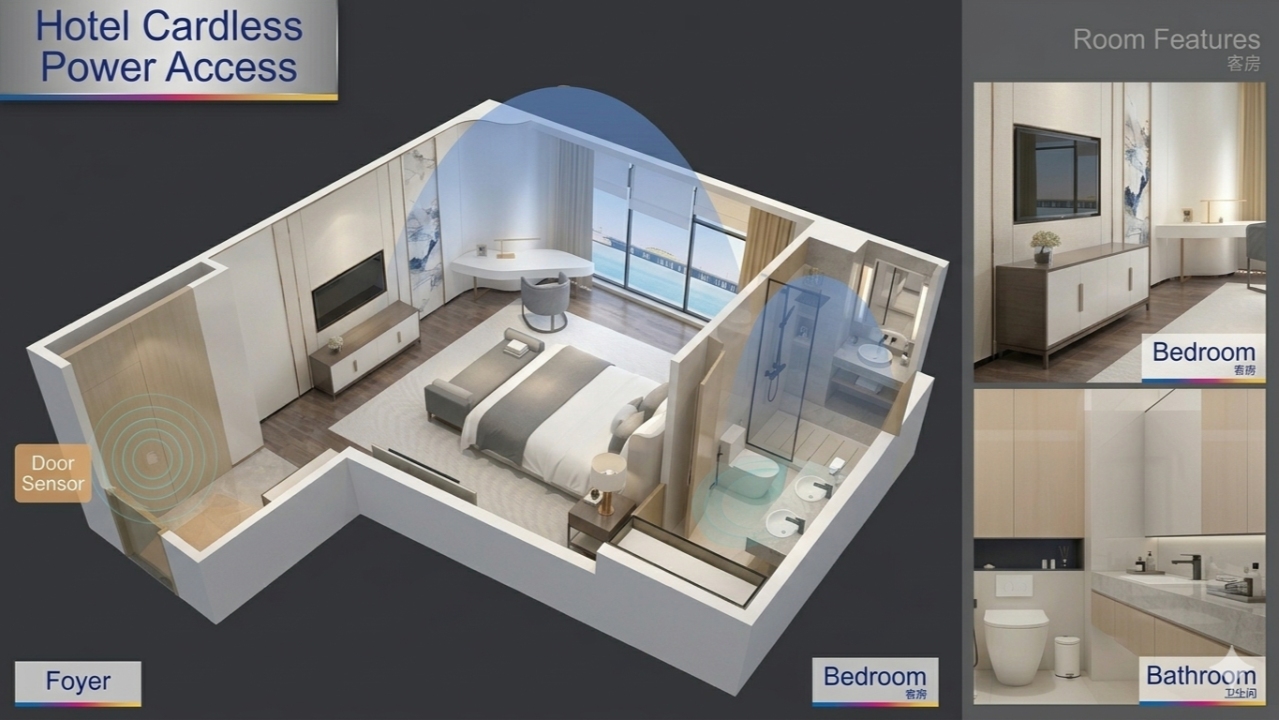
EasyDetek's hotel sensing solution changes the control basis from card status to human presence. The recommended baseline configuration combines one door sensor with three radar sensors selected by room function, helping the system judge whether the room is occupied and respond with more appropriate power, lighting, and air-conditioning logic.
 radar sensing overview" />
 Card-based power control is simple, but the operating logic is limited: inserted card means power on, removed card means power off. In real hotel operation, this does not always match the room's true occupancy status.
A guest may leave a spare card in the slot to keep the air conditioner running. A room attendant may insert a card during service. Some projects may also use ordinary cards that can keep the switch activated. In these cases, the room appears "occupied" to the power system even when no guest is inside.
Radar sensing adds the missing layer: it helps the room control system understand human movement and presence inside the space, so energy-saving logic can be based on the actual room state rather than the card alone.
Different areas of a hotel room require different sensing logic. The entrance needs fast movement response. The bedroom needs static presence detection. The bathroom may need either full-area motion detection or more precise zoning, depending on the layout.
| Area | Recommended Sensor | Control Purpose |
|---|---|---|
| Entryway | Motion radar | Fast entry detection and lighting response |
| Bedroom | 24GHz presence radar | Static human detection for sleeping or low-motion states |
| Bathroom | 5.8GHz motion radar or 24GHz presence radar | Full coverage or zoned detection based on the room layout |
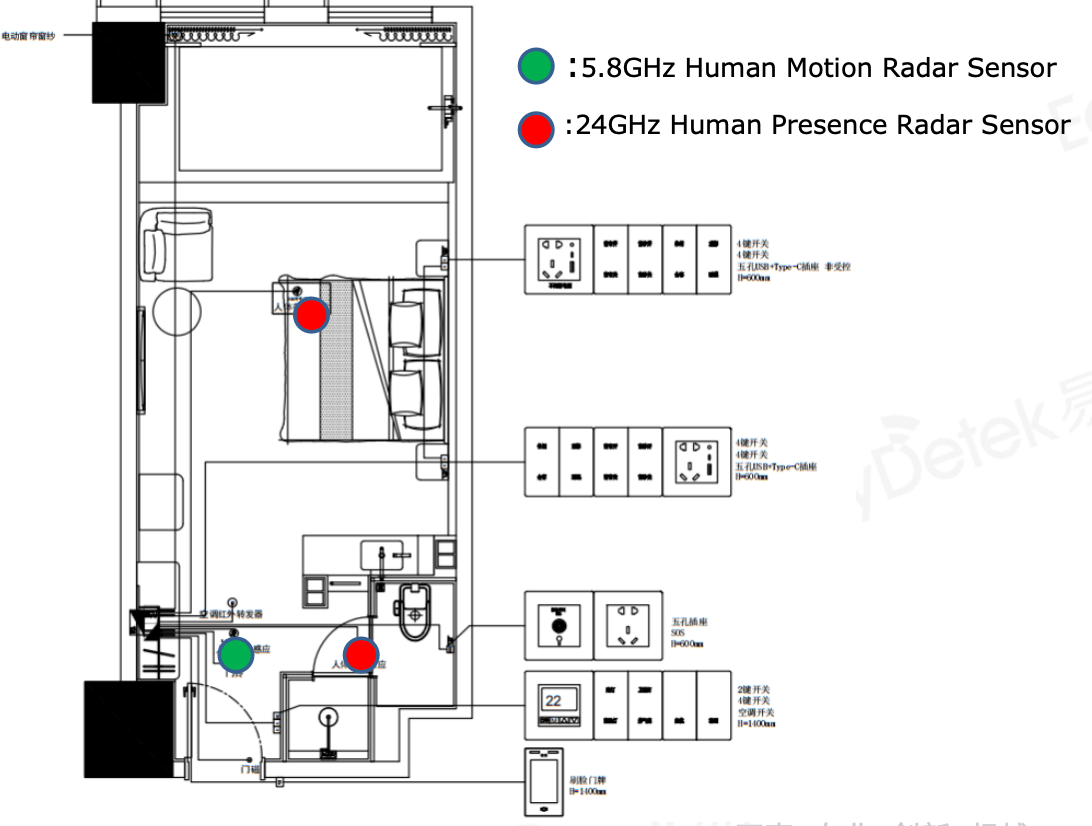
Install a motion detection radar near the entrance, typically 1-1.5 meters from the door.
Because microwave radar can penetrate wooden doors, keeping distance from the door helps reduce unwanted triggers from corridor movement while maintaining a fast response when a guest enters.
Install a 24GHz presence radar above the bed and avoid placing it close to curtains or windows.
A practical reference distance from curtains is ≥ 2.7 meters. The goal is to detect low-motion states such as sleep breathing while reducing interference from moving fabric or window-side activity.
For standard requirements, a 5.8GHz motion radar can cover the bathroom and shower area.
For higher comfort or more complex layouts, a 24GHz presence radar is recommended. Zoning can help avoid unnecessary triggers from adjacent corridors while maintaining lighting during low-motion use.
Selection principle: use 5.8GHz radar where motion response and wide coverage are enough; use 24GHz radar where static presence, zoning, or more precise boundary control is required.
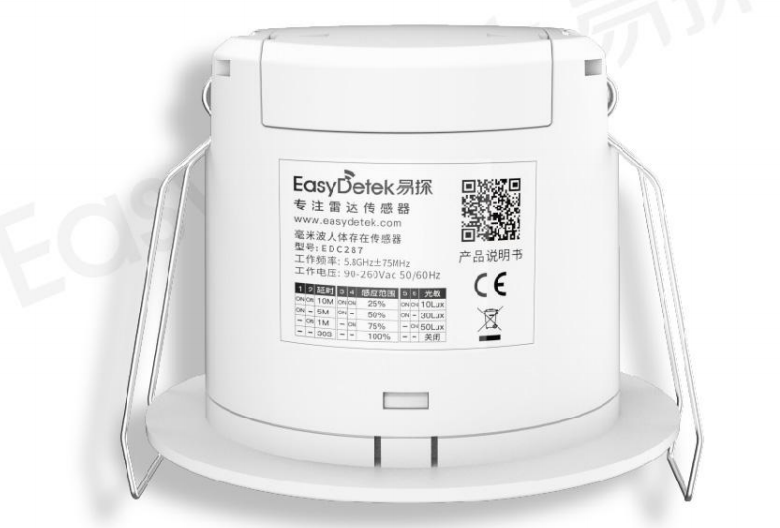
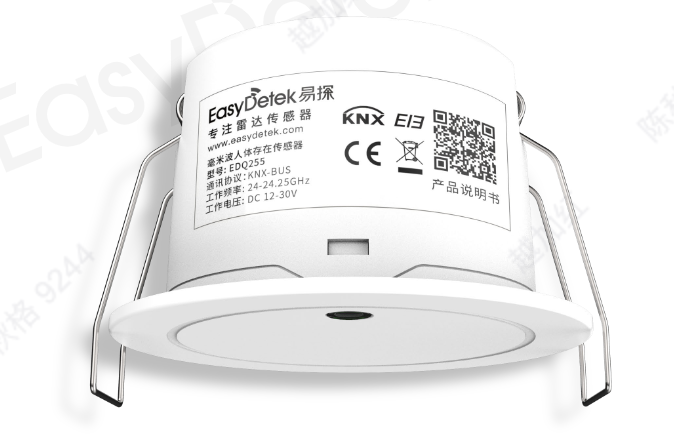
When the room is empty but a card remains inserted, radar presence sensing gives the system another basis for adjusting air conditioning, lighting, and other loads according to hotel rules.
The room can respond to door status, entry movement, and actual presence, instead of relying only on whether the card switch is activated.
Scenario-based sensor selection helps reduce avoidable false-trigger and missed-detection risk in rooms with curtains, bathrooms, and partitions.
Compared with PIR-only or card-only solutions, radar sensing gives the room control system more useful occupancy information. This makes it possible to shorten unnecessary delay time and reduce empty-room operation while still protecting the guest experience.
This configuration is a baseline model, not a fixed template for every room. In real projects, the sensing zones, radar types, installation positions, and automation logic should be adjusted according to hotel type, room layout, control system, and commissioning requirements.
Luxury hotels, business hotels, resorts, and long-stay apartments may require different detection priorities. The final goal is the same: reduce unnecessary energy use when the room is empty, while keeping the experience stable and comfortable when the guest is inside.
Share the room layout before sampling.
EasyDetek can review the application scenario, installation environment, and required output or protocol before recommending a suitable hotel radar sensing configuration.
Return

Official Information Hotline: +852 8400 2558
Website: https://www.easydetek.com/en/Email: info@easydetek.com
Shenzhen EasyDetek Technology Co. Ltd ,
4th Floor, Building 3, Park A,
Xin'an COFCO Industrial Park, Bao'an District, Shenzhen